
Songhai Newsletter- June 1, 2024
Songhai is an organization headquartered in Porto-Novo, Republic of Benin, that promotes sustainable development as a viable option to fight poverty in Africa. It sees itself as a laboratory of African renaissance. Songhai was founded by Fr. Godfrey Nzamujo in 1984, his vision over the past thirty years has centered on sustainable, regenerative/ organic agriculture that produces more and better with less as foundational in rebuilding Africa. The people at Songhai are not only self-sufficient to ensure food security in their communities, but their socio-economic activities have positive effects on their neighboring communities. “Waste to wealth” is the driving philosophy of the Songhai movement.
Songhai is a zero- waste project. Everything is recycled. It produces its own energy and grows crops that are fertilized by the recycled waste products of animals and plants. At every level, byproducts from one area are used in another. Crop waste is used to feed the animals and their waste is turned into biogas; a natural fuel that powers the farm.
Songhai sells food and vegetables at markets around the country to generate income. They produce bananas, mushrooms, pigs, fish, chickens, ducks, varieties of beans, maize, cashew nuts, and rice. They make their own machines at the foundry, bottle drinking water, and grow fish for people.


He wants to transform Africa from a continent filled with used electronics, clothing, and other various donations from well-meaning countries to a continent that makes its own energy and food and is in the driver’s seat for its own future. He says, “We’ve been importing poverty and exporting wealth. It’s time to change that mentality.”
He is building “green rural cities”, the opposite of large industrial cities like Lagos, where the poverty is rampant and unemployment high. He believes that building these small communities starts with respecting nature and transforming the soil so it can produce enough food for its millions of people. But even more than that, Songhai produces pride and respect for each worker, knowing that their contribution is important. They have been able to transform from being recipients of the good will of other countries into being the producers of their own future.
Over 30,000 young people have been trained at Songhai since 1985 and have gone on to establish their own farms and communities with the same principles. Nzamujo has established a Songhai Leadership Academy which teaches young people to put Songhai principles into practice in their own countries and communities. Songhai continues to help them financially and as a community until they can be independent.
Songhai is not just about feeding people- it is providing jobs and giving the youth of Africa a hope for their future and a way out of poverty and hopelessness. Songhai has established many projects in other African countries, including Nigeria, Burkina Faso, Mali, Chad, The Gambia, Ghana, Mauritania, the Democratic Republic of the Congo, Liberia, Togo, Uganda, Senegal, Niger, and has even reached as far as Guadalupe and Martinique in the Caribbean.
Father Nzamujo was awarded the Africa prize for leadership in 1994 and the United Nation’s Food and Agricultural Organization’s 70th year award in 2017. Songhai has recently been working with the World Food Program in Ghana and is even now, beginning work in Niger to start new sites in a country undergoing great political upheaval. In the past few weeks, delegations from the Mastercard Foundation based in Canada and a South Korean delegation have met with Nzamujo.
All this has happened because of the vision of one man. Since its inception, over 8 million people have visited Songhai. Some are just visitors, but many have been inspired to make changes in their own communities and countries. Now there are thousands of people helping that vision become a reality. In the coming years when we are coping with increasing population and undeniable climate change, enabling people to provide healthy food for themselves while preserving the land and soil for future generations is vital to our world.


Our hope is to ensure that the concepts and philosophy of Songhai can gain even more recognition and continue to change the world for the better.
There are many “new beginnings” at Songhai recently, and we’d like to tell you about a few of them.
There are many problems in the world today, including climate change, food insecurity, poverty, energy needs, and youth unemployment, just to name a few. Father Nzamujo always emphasizes that the world can’t continue to try to solve these problems the old way. That way has not worked. Songhai is trying to come up with new and innovative solutions to these world problems.
One solution is through energy. Songhai, in the past few years, has installed many solar pumps and panels and is almost completely powered by the sun. The solar pumps are used to pump the water from the lakes and rivers to irrigate all the crops that are grown there. Almost all the sites in Benin are using solar power at the present time.


Songhai has always been a leader in combatting food insecurity, but producing the microorganisms that add to the soil had helped improve the growth and yield of every crop. Songhai produces and markets these microorganism solutions (EMS) to be used on crops everywhere. They hope to produce more of this solution in their laboratories to be sold and used all over Africa to help combat land degradation and enrich the soil.
Songhai has provided jobs for so many young people in the agriculture sector, and the trainees take and use these methods of organic and sustainable agriculture in their own countries and farms.
On a personal note, I’ve have had the opportunity to visit Songhai twice, and even though I had heard many things about it from Father Nzamujo over the years, I wasn’t prepared for the reality. Songhai is more impressive than I could have ever imagined. When I walk through the center, I see crops of tomatoes and corn and cassava, pens of chickens and turkeys, pigs, goats, an African breed of cows, horses and mules. I see large ponds which are full of tilapia and catfish, and ponds which house the smaller fish. There are three restaurants to feed the large amount of people who work, train, and visit the facility.
Machine shops provide and repair all the farm equipment, and a huge gas facility provides natural gas for the center. Solar panels are everywhere, providing energy so that Songhai will never have to rely on outside sources. Ostriches and crocodiles provide interest for the tourists and a swimming pool is there for weekend visitors, especially for the children. It’s a delight to walk through the center and see the life and activity that goes on there every day.
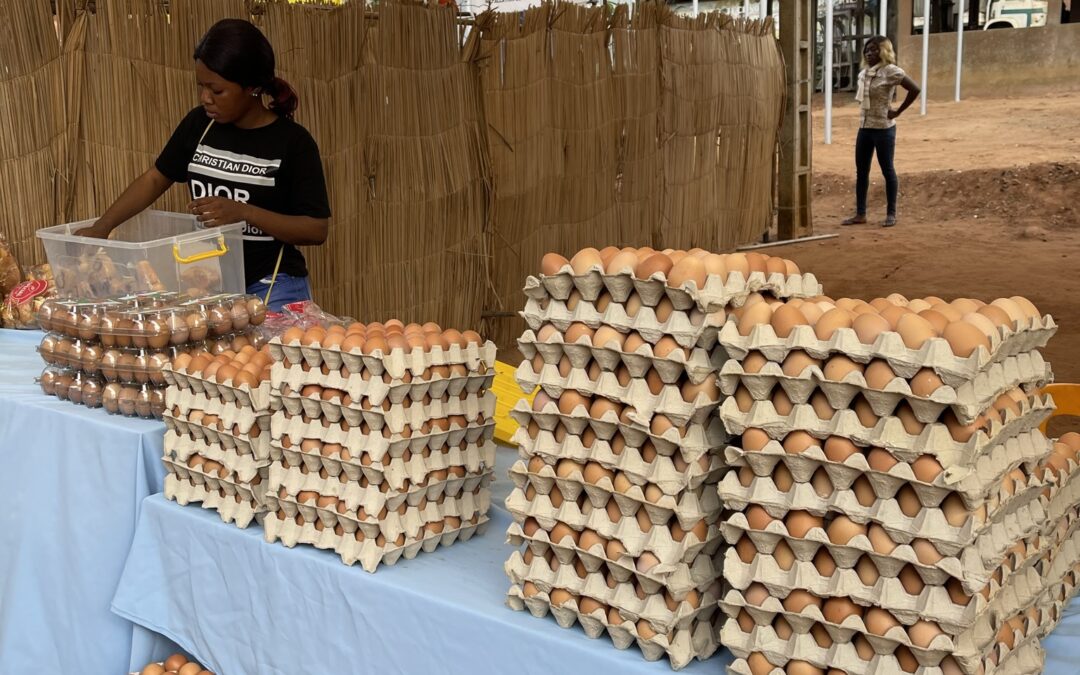
At the entrance to Songhai, people sell eggs every morning, and the store is full of products that Songhai produces: jam and moringa powder, canned food, yogurt, bread, bakery goods and other staples for people from the city.
Songhai is not just words; it is a working agricultural center that trains youth and provides jobs, recycles everything, turns waste into usable compost for crops and energy, and even more than that, is a community of people working for a common goal. I could see it in the faces of the people who worked and lived there. They all had a desire to make something not only of themselves, but to make their families, farms, and countries, a better place to live.


Songhai has worked with the United Nations Development Program, the World Food Program, the Mastercard Foundation of Canada, and the ministries of agriculture in many West African governments, to bring about this change.
Songhai is a solution to poverty in the region, a help in solving climate change, and a way of bringing peace, not conflict, to a world that so desperately needs hope for the future.
“Songhai”, a 501c3 organization, is currently being reinstated in the State of California after forty years. I have become the current president, and I will let you know when the organization will be accepting tax-free donations again.
Father Nzamujo and I wanted to keep you up-to-date on all the new and exciting things that were happening at Songhai and we hope you’ve enjoyed reading about them. I’ll be returning to Songhai again this summer. I can hardly wait- and I’ll give you an update when I return. Thanks for reading,
Susan Mattern
President – “Songhai”


